



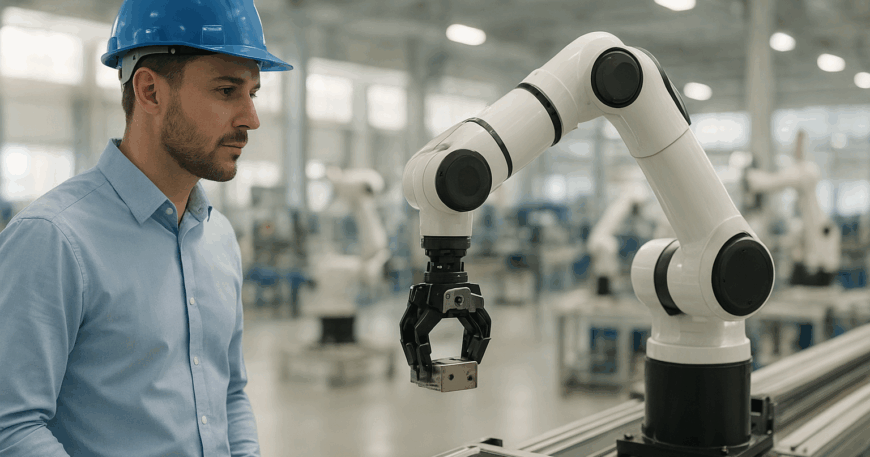
Introduction — Mental health in modern industry
Many workplace leaders now face a dual challenge: maintaining competitive global operations while protecting employee mental health. Modern supply chains demand speed and flexibility. They also push workers into repetitive, high-stress roles, frequent travel, and long shifts that increase burnout and anxiety.
Robotics can address these pressures by reducing dangerous and repetitive tasks, improving workplace ergonomics, and enabling remote supervision. When teams rely on robots for hazardous or monotonous work, humans can focus on decision-making, quality control, and creative problem solving. That shift reduces stress and increases job satisfaction.
Research output reference: -1762753233
Section 1: Robotics in Manufacturing — Driving Precision and Safety
How robots change the factory floor
Robotics improve precision and reduce manual strain. Manufacturers gain consistent quality at higher throughput. Robots handle heavy lifting, repetitive assembly, and hazardous exposure. Humans handle oversight, troubleshooting, and complex assembly tasks.
Practical example: Automotive assembly
In an automotive plant, collaborative robots (cobots) perform bolt tightening and parts handling. They reduce musculoskeletal injuries among line workers and cut rework rates. Supervisors report fewer overtime incidents and lower sick leave after automation of repetitive tasks.
- Key features: precise torque control, 24/7 repeatability, safety sensors
- Benefit: reduced workplace injuries and improved first-pass yield
- Actionable insight: start with a pilot cell for high-reject processes
Section 2: Supply Chain and Logistics — Speed, Visibility, Carbon Reduction
Robotics beyond the factory
Robotics accelerate warehousing, packing, and last-mile delivery. Automated guided vehicles (AGVs) and autonomous mobile robots (AMRs) reduce manual travel time and reduce packing errors. Robotics also enhance data capture for real-time inventory visibility.
Practical example: Automated fulfillment center
A global electronics distributor installed AMRs to move pallets and pick components. The center decreased order lead time and reduced forklift-related incidents. Staff experienced less physical strain and clearer shift patterns, which improved morale.
- Key features: dynamic routing, inventory scanning, energy-optimized charging
- Benefit: lower operating cost per order and improved on-time delivery
- Actionable insight: pair AMRs with warehouse management systems (WMS) for immediate gains
Actionable steps for carbon-neutral logistics
Robotics can support carbon-neutral strategies. Use energy-efficient robots, schedule charging during low-carbon grid hours, and optimize routing to reduce empty miles. Combine these steps with supplier verification to measure embodied emissions.
Section 3: Factory Verification and Compliance — Real-Time Assurance
Robotics for verification and auditing
Robotic solutions provide consistent inspection and documentation. Drones and robotic crawlers inspect roofs, tanks, and large machinery. Vision systems detect deviations that humans might miss.
Practical example: Remote factory verification
A sourcing team used drones and mobile robots to audit a supplier site. They collected timestamped images, environmental data, and process video. The team verified compliance without extended onsite visits, reducing travel stress on employees.
- Key features: high-resolution imaging, automated checklists, tamper-evident logs
- Benefit: faster audit cycles and improved supplier transparency
- Actionable insight: integrate robotics-derived data into your supplier scorecards
Section 4: Production Optimization — Data, Robotics, and Workforce
Where robots unlock productivity
Robotics deliver repeatability and collect high-frequency operational data. Teams can analyze this data to identify bottlenecks and optimize takt time. Robots also help standardize changeovers and reduce variability.
Practical example: Electronics contract manufacturer
A contract manufacturer introduced robotic pick-and-place systems. Engineers used cycle-time data to re-sequence workstations. Production increased while headcount shifted toward inspection and engineering roles.
- Key features: integrated sensors, machine-to-machine communication, predictive maintenance
- Benefit: higher OEE (Overall Equipment Effectiveness) and reduced unscheduled downtime
- Actionable insight: pair robotics deployment with operator retraining programs
Section 5: Construction Material Sourcing and On-Site Automation
Robots in construction and material handling
Construction teams use robotics to cut waste, improve safety, and speed installation. Automated bricklaying, robotic saws, and material-handling UAVs reduce manual risk and improve accuracy for prefabricated elements.
Practical example: Prefabricated panel installation
A construction firm used robotic cranes and guided systems to install prefabricated panels. They reduced onsite labor intensity and shortened project timelines. Site supervisors reported fewer high-risk lifting tasks and more predictable schedules.
- Key features: targeted automation for heavy lifts, precise placement, integration with BIM
- Benefit: fewer onsite injuries and faster project delivery
- Actionable insight: source materials compatible with robotic installation to maximize gains
Implementation Roadmap and Compliance Considerations
Practical steps procurement teams can take now
Start with small, measurable pilots that focus on safety, quality, or carbon reduction. Use supplier audits to identify repeatable tasks suitable for automation. Plan workforce transition with training and role redesign.
- Assess high-frequency, high-error processes first
- Create a phased investment plan with clear KPIs
- Train a cross-functional team to manage robot deployments
- Document safety and regulatory compliance for each deployment
Regulatory and compliance checklist
Follow local safety standards and import/export rules for robotic equipment. Confirm electrical, mechanical, and emissions compliance. Add robotics-specific clauses to supplier contracts and verify them during factory audits.
Conclusion — Business Benefits and Human Impact
Robotics improve safety, cut costs, and drive consistent quality across manufacturing, logistics, verification, and construction contexts. They also reduce repetitive strain and mental stress for frontline workers. Integrating robotics creates resiliency while supporting decarbonization goals.
Procurement and sourcing teams that combine robotics with robust supplier verification and workforce planning will gain a competitive edge. Start with small pilots, measure outcomes, and iterate. Focus on benefits for people and the planet as well as the balance sheet.
For expert guidance on robotics-driven sourcing, factory verification, carbon-neutral supply chains, or importing robotic equipment, contact our team to discuss practical next steps.