



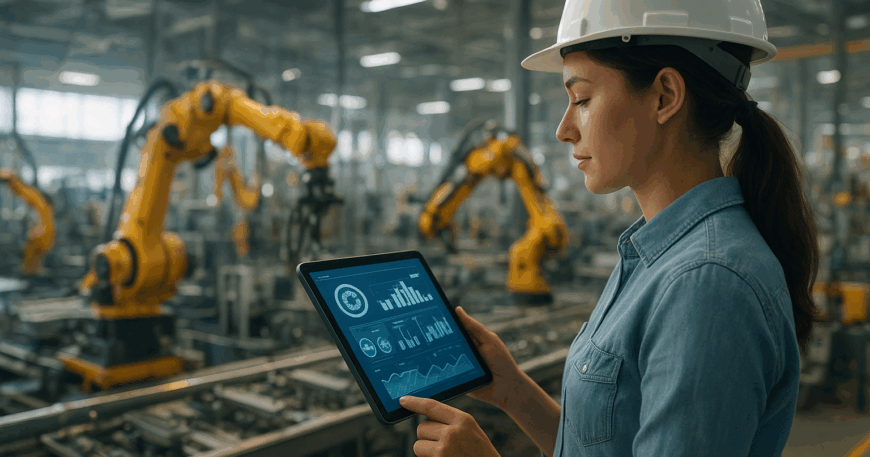
Introduction: Mental Health in the Era of Smart Factories
Modern manufacturing deploys more automation and data analytics than ever before. These advances drive efficiency, but they also change daily work for operators, supervisors, and logistics teams.
Companies must address workforce mental health alongside technology adoption. Anxiety about job security, cognitive overload from new interfaces, and extended remote monitoring can erode productivity and compliance.
This article links the rise of smart factories in 2026 with practical sourcing and supply chain actions. We highlight validation practices, carbon-neutral planning, and production optimization while keeping human factors in view.
Section 1: Why Smart Factories Matter in 2026
Key industry drivers
Smart factories now combine edge computing, AI, robotics, and digital twins. Manufacturers use these systems to reduce lead times and stabilize quality.
Global sourcing teams rely on real-time factory data to make import/export decisions and manage multi-country production networks.
Reference: Internal research output ID -1763530825 informs our scenario planning and risk models for 2026 deployments.
Business outcomes to expect
- Faster product iterations and reduced time-to-market.
- Improved traceability across suppliers and materials.
- Lower per-unit energy and waste through predictive controls.
- Clearer compliance records for customs and regulatory audits.
Section 2: Production Optimization and Practical Examples
How smart systems improve manufacturing performance
Factories collect sensor data across lines. Teams analyze that data to reduce downtime and balance throughput.
Digital twins let engineers simulate changes before committing capital. Supply chain teams use the same models to forecast inventory and allocate orders.
Practical examples
- Example 1: A textiles plant applies predictive maintenance to sewing machines. It cuts unscheduled downtime by 40% and reduces overtime costs.
- Example 2: A modular construction supplier integrates material tracking with the production scheduler. It avoids shipment delays and reduces on-site rework.
- Example 3: A component supplier uses automated optical inspection to flag defects early. Rejection rates fall and warranty exposure declines.
Action steps for operations teams
- Map existing processes and identify the top three failure modes.
- Install targeted sensors and set baseline KPIs for each line.
- Run pilot projects in a single cell for 90 days, then scale using a phased governance model.
Section 3: Carbon-Neutral Supply Chains and Sustainability
Linking smart factories to carbon reduction
Smart factories provide the data needed to decarbonize. Energy management systems measure usage by asset and shift.
Procurement teams can use validated emissions data to choose suppliers and routes that reduce scope 3 emissions.
Benefit-driven strategies
- Optimize energy use with demand response and load shifting to lower utility costs and emissions.
- Source low-carbon materials based on verified supplier footprints.
- Use transport optimization to lower fuel consumption across multimodal networks.
Implementation example
A building materials manufacturer installed rooftop solar and linked production schedules to solar forecasts. The plant cut grid consumption during peak hours and lowered costs per unit.
Section 4: Factory Verification, Compliance, and Cross-Border Trade
Strengthening verification processes
Global buyers require proof of capabilities, social compliance, and environmental claims. Smart factories offer digital evidence.
Use video audits, authenticated sensor logs, and tamper-evident chain-of-custody records to validate supplier claims.
Practical compliance framework
- Standardize documentation packs for each supplier: process maps, machine lists, and certified test reports.
- Conduct remote verification where safe and augment with on-site audits for critical vendors.
- Maintain a centralized digital dossier for customs and third-party inspections.
Import/export considerations
Automated documentation reduces clearance delays. When factories provide structured product and compliance data, customs brokers process shipments faster.
Ensure HS codes, country-of-origin data, and any preferential trade information are machine-readable to speed up cross-border flows.
Section 5: Construction Material Sourcing and Smart Factory Integration
Why construction benefits from smart factory approaches
Construction materials require strict dimensional accuracy and traceability. Smart factories enforce tolerances and record batch-level data.
Buyers can link material specifications to site schedules and reduce overordering and waste.
Example workflows and metrics
- Prefabricated panels: Integrate CNC logs with BIM models to ensure fit and reduce site rework.
- Cement and aggregate supplies: Use automated sampling and inline quality checks to maintain strength specifications.
- Steel components: Track heat numbers from mill to finished part to ensure structural compliance.
Roadmap to implement
- Define critical-to-quality attributes for each material type.
- Deploy batch tracking and link records to purchase orders and delivery notes.
- Train sourcing and project teams to read factory-generated QA reports.
Delivering Value: People, Processes, and Technology
Addressing workforce wellbeing and adoption
Deploy technology while supporting workers. Offer training, clear role shifts, and mental health resources.
Reduce cognitive overload by simplifying interfaces and automating routine tasks. Give operators time to learn and adapt.
Measurement and continuous improvement
Track both technical KPIs and human-centered metrics.
- Technical: OEE, first-pass yield, energy per unit, and on-time delivery.
- Human-centered: worker fatigue events, training completion rates, and job-satisfaction surveys.
Conclusion: Actionable Next Steps for Sourcing Leaders
Smart factories will shape global trade in 2026. Sourcing teams that pair verification, sustainability, and production optimization will reduce risk and lower costs.
Start with small pilots, measure outcomes, and scale with governance. Protect workforce wellbeing as you introduce new systems.
For project-specific guidance or factory verification support, use the contact resources below. We will respond with a practical roadmap tailored to your network.